In early 2020, the Texas Tech University Health Sciences Center’s new Institute of Anatomical Sciences was ready to welcome students to teach and visitors to tour.
Most anatomical facilities are renovations of old spaces, and as far as the institute faculty are aware, there had not been a ground-up construction of such a facility in the United States in about 20 years.
The planned grand opening of the institute attracted a lot of interest and RSVPs, but due to the COVID-19 pandemic, it never happened. That didn’t stop the faculty from finding the safest way to bring students back on campus and into the new labs.
Dr. Kerry Gilbert is an administrator for the institute, as well as an anatomist and educator. He and the anatomical staff worked with the dean of the School of Health Professions and the TTUHSC president to create a number of plans to facilitate in-person learning.
“In the midst of something that nobody understood, we were able to stay committed to the fact that education, using a dissection model for physical therapists, occupational therapists, athletic trainers, PhD, PA was important,” Gilbert recalled. “At the same time, the rest of the state, everybody shut down their labs.”
During COVID, many medical and health professions programs postponed or eliminated cadaver dissection courses. And Gilbert said some never brought them back after the pandemic ended.
“So what this place represents, to me, is the TTUHSC drove a stake in the ground in West Texas and said, ‘We're never departing from this,’” Gilbert explained. “We have a self-sufficient Willed Body program that has grown tremendously in the last couple of years, and we have sufficient donors that are willing to support this effort, and we're not going to change from this. This is hard. This is not an easy thing to manage.”
A key component in the ability to return without a single COVID contraction was the size of the facility and its dissection lab, allowing students and faculty to spread out. The dissection lab alone is built for 300 students and 50 staff members, 4-5 people for every patient. It is also equipped with dissection tables with built-in tanks created specifically for the institute’s lab, designed for preservation, efficiency, and safety.
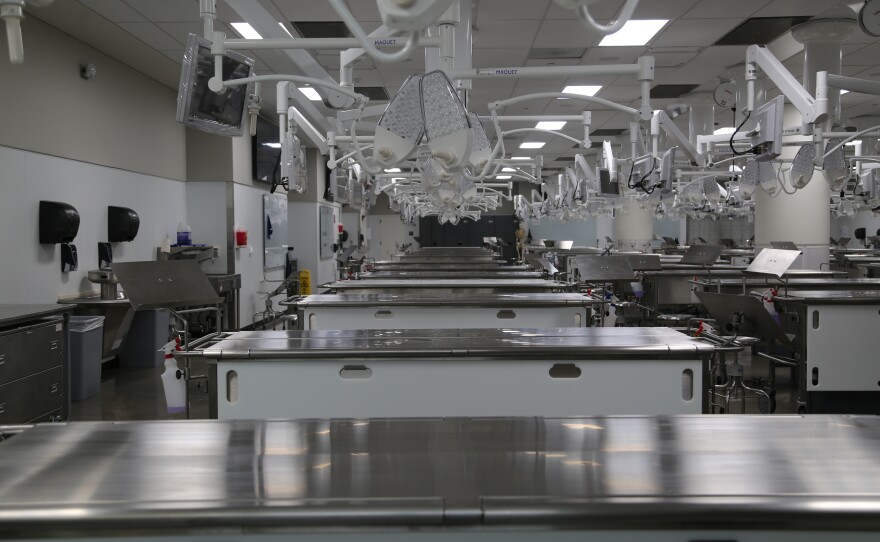

“This is, by all accounts, the largest and most technologically advanced anatomical dissection facility in a university in the country,” Gilbert said. “[Lori] Rice-Spearman says, if you're the largest in Texas – we know that for a fact – but if you're the largest in Texas, you're probably the largest in the country. If you're the largest in the United States, you're probably the largest in the world.”
While there are other anatomical centers in the state, this is the only anatomical ‘institute’ in Texas.
The facility is 20,000 square feet. The previous space for anatomical research and the Willed Body Program was in a 7,000-square-foot basement.
Jason Jones is the director of the Willed Body Program at the Institute of Anatomical Sciences. He took over in 2016, after his predecessor Claude Lobstein retired.
Jones said the medical school began in the basement of the former Drane Hall Building.
“That's not very kosher, but that was the kitchen in the dormitories,” he explained. “Well, that's where the first anatomy lab actually was created. In the old basement of Drane Hall.”
“No longer a kitchen,” Gilbert clarified.
Lobstein oversaw the program for more than 40 years and helped to establish the Willed Body Program in 1974.
The former space wasn’t big enough for teaching, training, and research to be conducted concurrently. Jones said it was also a bit “doom and gloom,” despite state-of-the-art technology.

When funding came for the new facility, and with Lobstein ready to retire, he contacted Jones.
Education, training, and research are goals of the institution, with an overarching focus on interdisciplinary practices and collaboration.
The facility has hosted or worked in tandem with the School of Health Professions, students in Speech Language and Hearing, kinesiology, biology, undergraduate students of Texas Tech and Lubbock Christian University, EMS and paramedic trainings, and even established professionals come to practice procedures and expand their skills.
Jones explained that outside of Lubbock, the nearest level one trauma centers for the region are all six hours away, in Dallas, Albuquerque, and El Paso. Meaning that the Health Sciences Center serves professional flight nurses, doctors, paramedics, or anyone else who needs training and education from eastern New Mexico to southern Oklahoma, Alpine to Abilene, and San Angelo.
“Texans have always taken care of Texans, but West Texans are always the first to step up to take care of their region,” Jones said. “And this is TTU’s contribution back to all the support that was created for them in the early days of the creation of the medical school, etc., and being able to put clinicians back into the field in rural settings and in West Texas to serve those medical needs.”
In nearly six years of operation, Gilbert said there have probably been three days when every room in the facility was used by different groups.
The institute has a main staff of five people. Gilbert and fellow director Dr. Brandt Schneider are administrative staff, while Jones leads the Willed Body team with his two managers, Deanna Wise and Rex Johnson.
The Willed Body team has almost 90 years of combined deathcare experience between the three of them.
Not only does the Willed Body Program facilitate the training of incoming medical professionals, it also ensures that those who want to donate their bodies can do so with ease.
“But if also the Willed Body program wasn't here, what about all those individuals that donating their body to science is their wish to do so?” Jones posited. “So all those individuals here in the West Texas area and region that we serve have no means of executing that wish.”

Jones said about half the program’s donors come from Lubbock County or the four surrounding counties, and a majority of the other half come from anywhere from Wichita Falls to Del Rio.
“You'd be surprised,” he said. “Because you have a lot of … Tech alumnus that have moved off and may live in Houston or other places, and as long as they're willing to kind of work with us when they're outside of our normal service range, we'll bring them home back to Tech.”

The entryway of the Institute of Anatomical Sciences building is decorated with woodgrains, red accents, and the Institute's logo – Leonardo da Vinci's The Vitruvian Man – greeting donors and their families with warmth, not impersonal, blank white walls.
Staff with the Willed Body Program also work with other facilities to ensure that the wishes of the deceased are honored in a way that also best serves the family. Sometimes that means directing a donor to a closer sister-institute and sometimes it means walking the family through how to facilitate transporting the body.
The program averages 225-250 donors per year. Since about 1972, the program has received about 7,400 donors. And Jones said it has approximately 6,000 people registered as future donors.
He said there has been an increase of donors in recent years, which he attributes to more people talking about their death plans before they die.
“More people are more open about their wishes and wants,” he observed. “Some of it is heartfelt desires, and then others look at donation and cremation as a more economical means of disposition of their body.”
He compared pre-need death services to having home, auto, or medical insurance, something you might not want to use, but have just in case.
In his career, Jones said he has seen increased costs of deathcare services as the industry has become more commercialized and in some cases, a decrease in the quality.


“Unfortunately, we've seen, not only a trend from the deathcare of the funeral home side of deathcare, but it's also trended into the anatomical side of deathcare, as far as the commercialization aspect,” Jones said.
Even with their different approaches – Jones with a deathcare background and Gilbert with an educational one – the donors are at the center of all the work the institute does.
Gilbert said that all requests to use specimens for research, teaching, or training need to be approved by a committee to ensure it fits what the donor and/or their family wanted to contribute.
“If we can't do this in a dignified and respectful way, then we need to stop,” Gilbert said. “I teach anatomy for the School of Health Professions, and we try to make a really big point of: Look. You could study from books, you could study from models. It's not the same thing. The only way to learn the human body, in my opinion, is to study the human body.”
Gilbert’s classes have a moment of silence before they begin working on what he calls their first patient.
“Treat them with dignity and respect as you would a live individual,” he said. “That donor represents a life, lived memories, experiences, family. There's still family out there waiting to receive them back.”
Once a body reaches the institute, it is in what’s known as “final disposition,” much like a cemetery would be. After bodies are utilized, they’re cremated. Some families request the cremated remains be returned, and others don’t.
If a family does not request they be returned, the remains are commingled at an ossuary at Resthaven Funeral Home & Memorial Park, where families – and those who have benefited from the donors’ gifts – can honor them.
The anatomical staff organizes a service at Resthaven every year on Memorial Day for staff and students to thank the donors and their families. Invites go out to family members who had a loved one donated within a calendar year.
“We also have individuals that have had a family member donate 20 years ago, that still will come out and attend that memorial service that we have every year at Resthaven,” Jones said.

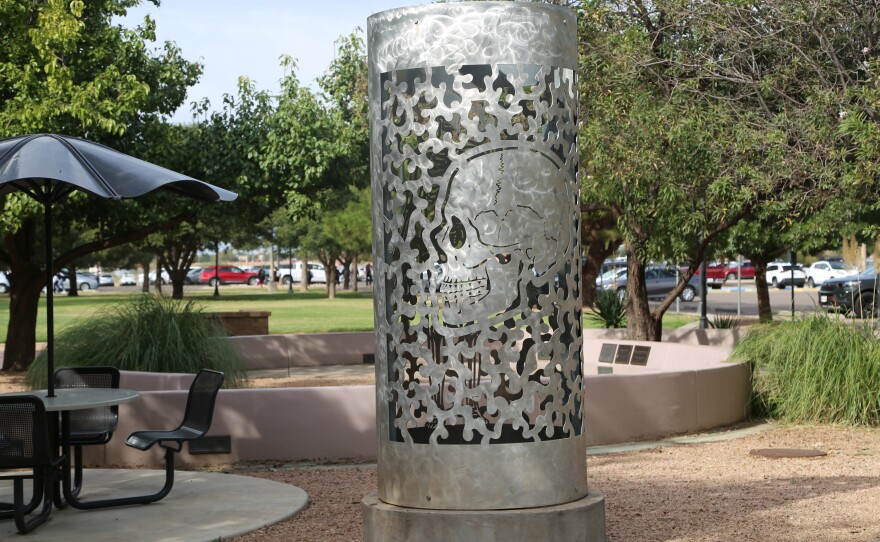
Outside of the Institute of Anatomical Sciences is a stone dedication, which reads “In honor of our past, present, and future willed body donors whose unselfish gifts support health sciences education and research.” and beneath that is the Latin “mortui vivos docent” which translates to “the dead teach the living.”
“Whenever you're able to have 35 or 40 different teachers, they're in front of you, so that you can see how, while we all are anatomically the same, we're just as anatomically different,” Jones said.
From the cross-sectioned specimens from the 1970s – before widespread access to CT Scan – to any of the hundreds of donors of the past six years, each patient is utilized for training and improvement of generations of medical professionals.
“There's no limit to what this area could do if we just have people that are interested in putting the time and energy and questions in to say ‘This is the question we have. How can we do it?’” Gilbert said.
In almost six years of being open, the Institute of Anatomical Sciences has served hundreds of donors, who gave their bodies to train hundreds of students and medical professionals across the region, who have gone on to care for thousands of patients. All of which, Jones and Gilbert believe, is the responsibility of the institute and its dedication to collaboration, education, and progress.